

Car Coolant Leak

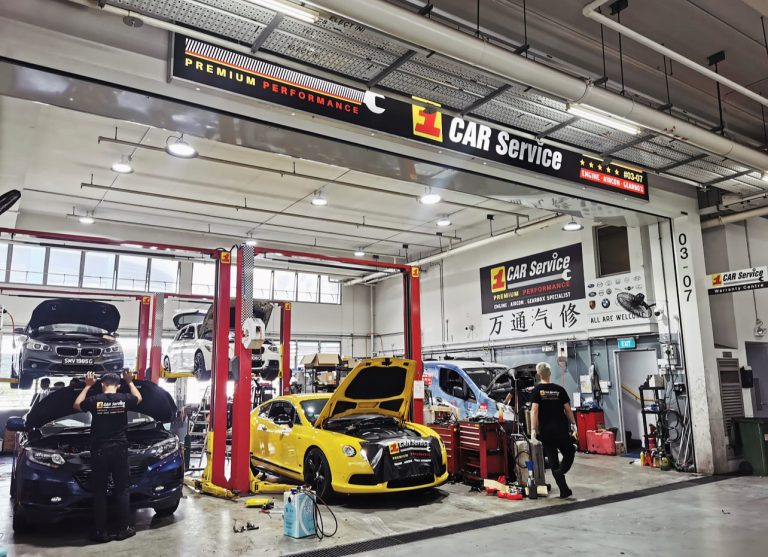
Technicians repairing a car's air conditioning system in best car workshop Singapore.

Your car is having a coolant leak. Here’s what it actually means.

A puddle under the bonnet, a sweet smell after a drive, a temperature gauge creeping up, coolant leak are rarely random. They trace to a handful of known failure points, each with a realistic cost and a real consequence if ignored. This is the diagnostic framework we use on every car that comes through our workshop.

Is it really coolant leak? Or just your aircon?

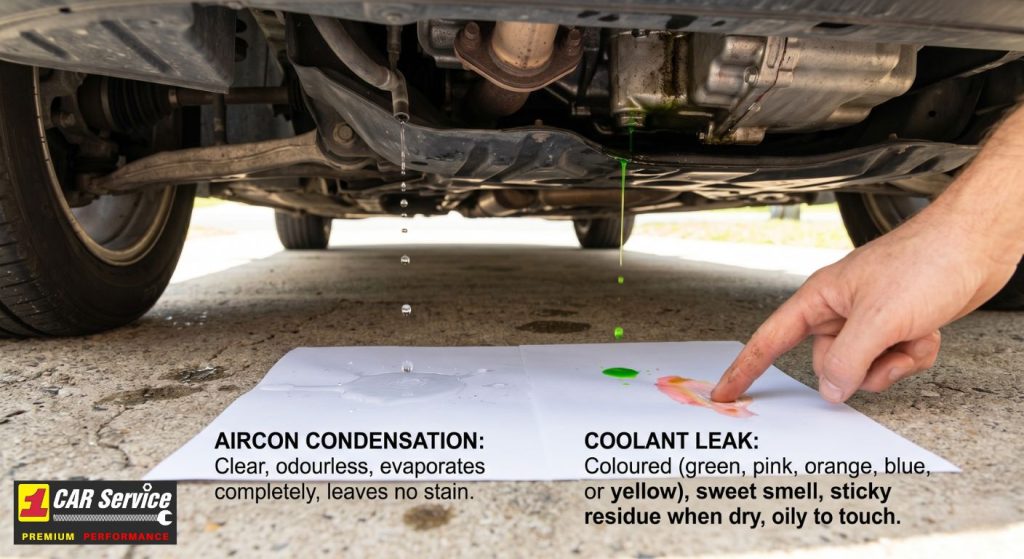
Before anything else, please check this. Many customers come in worried about a coolant leak when the puddle under the car is simply aircon condensation. Both are common, and it is easy to confuse the two.

Here is how to tell them apart.

Aircon condensation is:

  • Clear, like water
  • Odourless
  • Found roughly under the front passenger area, below the firewall
  • Most noticeable after you have been running the aircon, especially in traffic or on hot days
  • Completely normal and requires no action

Coolant is:

  • Coloured. Usually green, pink, orange or blue depending on the type
  • Slightly sweet smelling
  • Slippery to the touch, not watery
  • Often found further forward, near the radiator or under the engine bay
  • Always a sign that something needs attention

If the puddle is clear and odourless and appears only after aircon use, your car is fine. If the fluid has any colour or smell, please read on.

car coolant leak

If it is coolant leak, here is what it usually means.

Coolant leaks are rarely random. They trace to a handful of known failure points, each with a realistic cost and a real consequence if ignored. This is the diagnostic framework we use on every car that comes through our Sin Ming workshop.

Step 1. Recognise the symptom.

Coolant leaks announce themselves in five distinct ways. Most owners notice one. A proper diagnosis confirms which, because the symptom often points directly to the failure point.

i. Puddle under the car. Bright green, pink, orange, or blue fluid. Typically after the car has sat overnight.

ii. Sweet smell. A faint maple-syrup odour, strongest near the engine bay or through the vents.

iii. Temperature creeping up. Gauge climbing past midpoint in traffic, or a warning light on the dash.

iv. White exhaust smoke. Sweet-smelling steam from the tailpipe means coolant is entering the combustion chamber.

v. Low expansion tank. You are constantly topping up the reservoir but see no puddle. That is an internal leak.

A note on urgency. Symptoms iii, iv, and v mean the car should stop being driven. Continued driving risks head gasket failure, warped heads, or a seized engine. These repairs are 10 to 20 times the cost of addressing the original leak.

Step 2. Where coolant leaks actually come from.

Cooling systems fail in predictable places. A specialist knows which component to inspect first, which saves hours of diagnostic labour.

  • Expansion tank. Plastic fatigue causes hairline cracks, especially past 100,000 km.
  • Water pump. Seal degradation or impeller wear. One of the most common failure points.
  • Thermostat housing. Modern plastic housings warp and weep at the gasket face.
  • Radiator. End-tank splitting, core corrosion, or impact damage from road debris.
  • Coolant hoses and pipes. Heat cycling makes rubber brittle. Some cars use plastic pipes that fail outright.
  • Heater core. Internal leaks that show up as fogging on the inside of the windscreen, or wet carpets.
  • Head gasket. The worst case, and often the consequence of ignoring an earlier leak.

Let our professional team help you pin point the issue.

Step 3. What it realistically costs.

We are often asked for a price over the phone, and we understand why. But cooling system parts vary significantly by make, model, and even production year. The same component on two cars from the same manufacturer can differ by several hundred dollars depending on the chassis number.

What we can tell you honestly:

  • A simple hose or expansion tank replacement is among the most affordable cooling repairs.
  • Water pumps, thermostats, and radiators sit in the middle range.
  • Heater core and head gasket work are the most involved, and the most expensive.
  • Independent specialist pricing typically runs at roughly half of agent pricing for the same parts and the same workmanship.

Once we have your chassis number and a confirmed diagnosis from the pressure test, we give you a fixed written quote before any work begins. No surprises, no moving figures.

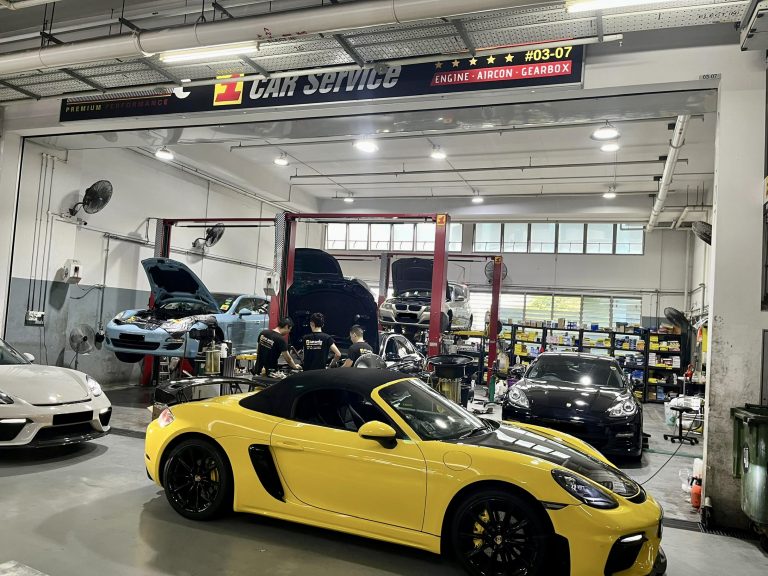
Multiple Porsche Servicing done at 1 Car Service Workshop, the best Porsche workshop for Porsche repair and maintenance.

Our coolant leak diagnostic process.

Pressure tests, not guesswork.

01. Cold-system pressure test. We pressurise the cooling system to factory spec and hold for 15 minutes. A leak reveals itself in seconds. No disassembly, no speculation.

02. UV dye trace, if required. For intermittent or internal leaks, we introduce a UV-reactive dye and run the car to operating temperature. Under UV inspection, the leak path becomes unambiguous.

03. Combustion leak test. If a head gasket failure is suspected, a chemical test on the expansion tank confirms whether combustion gases are entering the coolant, before we commit you to expensive internal work.

04. Written diagnosis and fixed quote. You receive the failure point, the part, the labour estimate, and photographic evidence. You decide. No pressure, no upsell.

Why customers come to 1 CAR for coolant leaks

Our workshop has spent over a decade building Singapore’s reference point for cooling-system and gearbox works. Other workshops send cases to us.

  • Located in Sin Ming AutoCity, Singapore’s largest workshop cluster.
  • OE-grade parts. Genuine or OEM-equivalent. Never pattern.
  • Fixed quotes, with no “while we’re in there” surprises.
  • Diagnostic-first approach. We do not replace parts on guesswork.
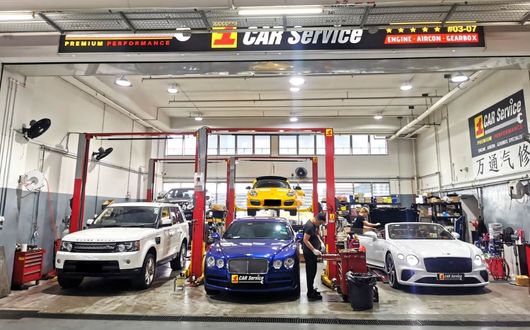
Mechanics working at 1 Car Service Workshop - Best Car Workshop Singapore

Testimonials

See why we are the best car workshop in Singapore

This is the first time I serviced my car at an external workshop. Had an issue with my transmission. DX had his mechanic check the issue on the spot and was able to advise in detail the issue, repair needed and cost. He communicated with great clarity what they were going to fix alongside their charges. DX is very genuine and definitely knows his stuff. I subsequently also had my aircon fixed. Both jobs were done well. Overall reasonable pricing with excellent customer service. Highly recommended.

Amazing experience at 1 Car! Started doing servicing with them last year, DX and his team are professional, transparent, fast and reliable. Everything was seamless and smooth, great responsiveness, superb customer service, good amenities, excellent competency in all aspect.

Really nothing but thumbs up for the great service, passion and professionalism from the team. Will definitely recommend to all friends and family to this reliable and trustworthy workshop.

Great service provided. DX is very friendly and eloquent, and patiently explained the various options for my car. I will definitely come again next time to do my regular maintenance service.

I stayed at the lounge during the service. There are coffee, tea, and drink provided there along with biscuit and candies. There is air purifier for the room as well. Free wifi inside – I didn’t use the wifi though. There is a charger on the desk as well in case the phone need to be recharged.

img

Questions we hear every week about coolant leak.

Is it safe to drive to your workshop with a coolant leak? If the temperature gauge stays at midpoint and you are not losing coolant rapidly, usually yes, for a short drive. If the gauge climbs, or you are topping up more than once a week, please do not drive it. Call us and we will advise on towing. Driving a critically low system for even 10 minutes can destroy the engine.

My agent quoted a figure that feels high. Is that normal? Agent quotes typically run roughly twice independent specialist pricing. That reflects showroom overheads, not superior workmanship. We use the same OE parts.

Do you use genuine parts? For critical cooling components such as water pumps, thermostats, and expansion tanks, we default to genuine or OEM (same manufacturer, different box). We will quote aftermarket alternatives transparently if a cost-conscious option exists, but we never substitute silently.

How long is the repair? Simple expansion tank or hose replacements are same-day. Water pumps and thermostats are 1 to 2 days. Major jobs involving engine disassembly are 3 to 5 days depending on parts lead time. We give you a firm timeline before you commit.

Do I need to book a diagnostic, or can I just come by? Please book. We reserve a bay and a technician, and we do not over-book diagnostic slots the way shops that treat it as a loss-leader do. A proper pressure test and written report takes 60 to 90 minutes.

Book a proper diagnostic. Then decide.

No obligation to repair with us. You leave with a written diagnosis, photographs, and a fixed quote, usable at any workshop you trust. Most customers stay. You do not have to.

Book an Appointment

Get in Touch With Us Today!

    8033 7708
    Chat with a specialist • No obligation